Proximity is Google’s #1 Local Search Ranking Factor
What is Geolocation?
Local SEO It’s the identification of the geographic location or proximity of a user or computing device through a variety of data collection methods. Most geolocation services use your router's IP address or your phone's GPS.
Local Search Results
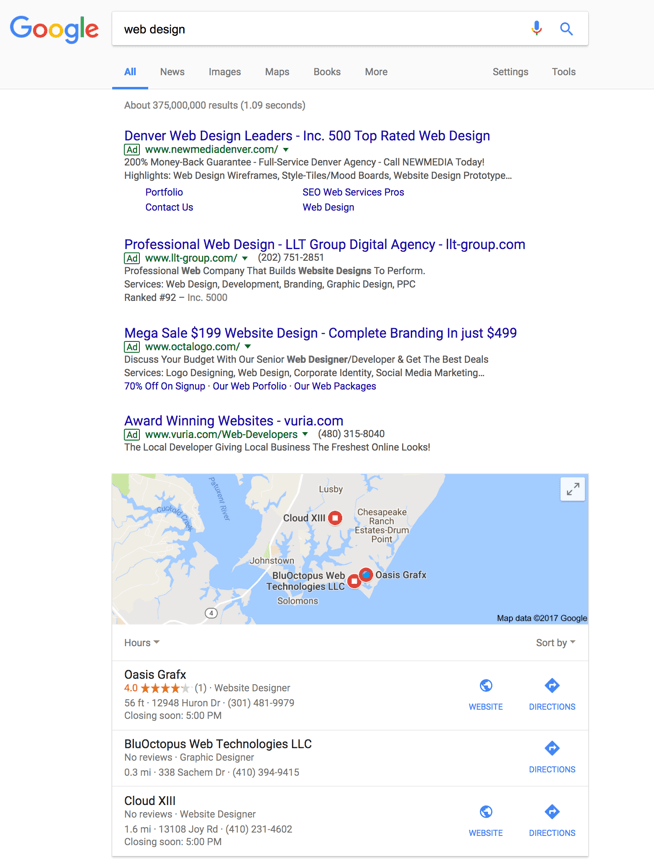
Have you searched for a service without including a location? We’ve noticed changes in search results and decided to test the system. The screen capture below shows a search for “web design” (location not included) and the results show Google Ads at the top that include a Denver company. But in the Local Pack, the map shows our location and listing along with two other companies near us.

How does Google deliver these search results on the desktop?
Most likely they use your IP address which pinpoints your location. These results can be confusing because the rest of the page contains links to sites that are outside of our area.
Local Pack Results
Not all businesses shown have claimed or verified their Google listing, have Google reviews, and only two of three link to websites.
How are you found on Maps?
Maps estimate where you are:
- Your web browser’s location information, IP address and your phone's location, if you have Location History turned on.
- You also must be logged into your master Google account, as well as have been logged into your Google account on your smartphone or your laptop as you moved about locally or traveled the web in the past.
How Google Maps Finds Your Current Location
Maps estimate where you are from these types of sources:
- Satellites: uses and knows your location within several thousand meters.
- The location of nearby Wi-Fi networks helps Maps know your location.
- Your connection to a cellular network which can be accurate up to a few thousand meters.
For most local searches, proximity appears to have more value than links, website content, citations, and reviews in the local pack rankings. However, these are important and shouldn’t be ignored when optimizing your website.
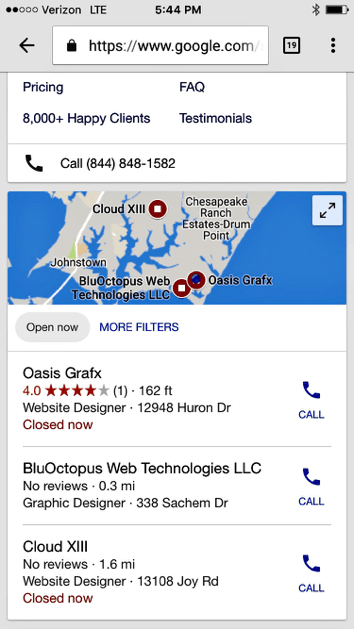
The screen capture to the right is the result of a non-geo specific search on a phone.
As you can see, the mobile results are very similar to the desktop results. From all our testing and research, it’s apparent that Google is focused on delivering local results on any device.
Because it's estimated that mobile searches will increase to 75% in 2017, we're optimizing for local search. Ranking factors to consider include:
Google My Business signals (proximity, categories, keyword in business title, etc.)
- Citation signals (NAP consistency [name, address, phone number], citation volume, etc.)
- On-page signals (presence of NAP, keywords in titles, domain authority, etc.)
- Link signals (inbound anchor text, linking domain authority, linking domain quantity, etc.)
- Review signals (review quantity, velocity, and diversity, etc.)
- Social signals (Google, Facebook, Twitter, and other social channels)
- Behavioral/mobile signals (click-through rate, mobile clicks-to-call, check-ins, etc.)
- Personalized search
- Optimizing for page speed and usability
Mobile-First Index
If you don't have a separate mobile version of your website, there's no need to worry. Google will use the desktop version of your site for ranking. However, your website must be responsive in design (mobile-friendly). Mobile-friendly is all about delivering a good user experience.
Google is and will continue to experiment over the coming months and say they will “ramp up this change when they're confident they can deliver a great user experience.”
Get more information about on Google's rollout of Mobile-First Indexing.
Ready to get found?