
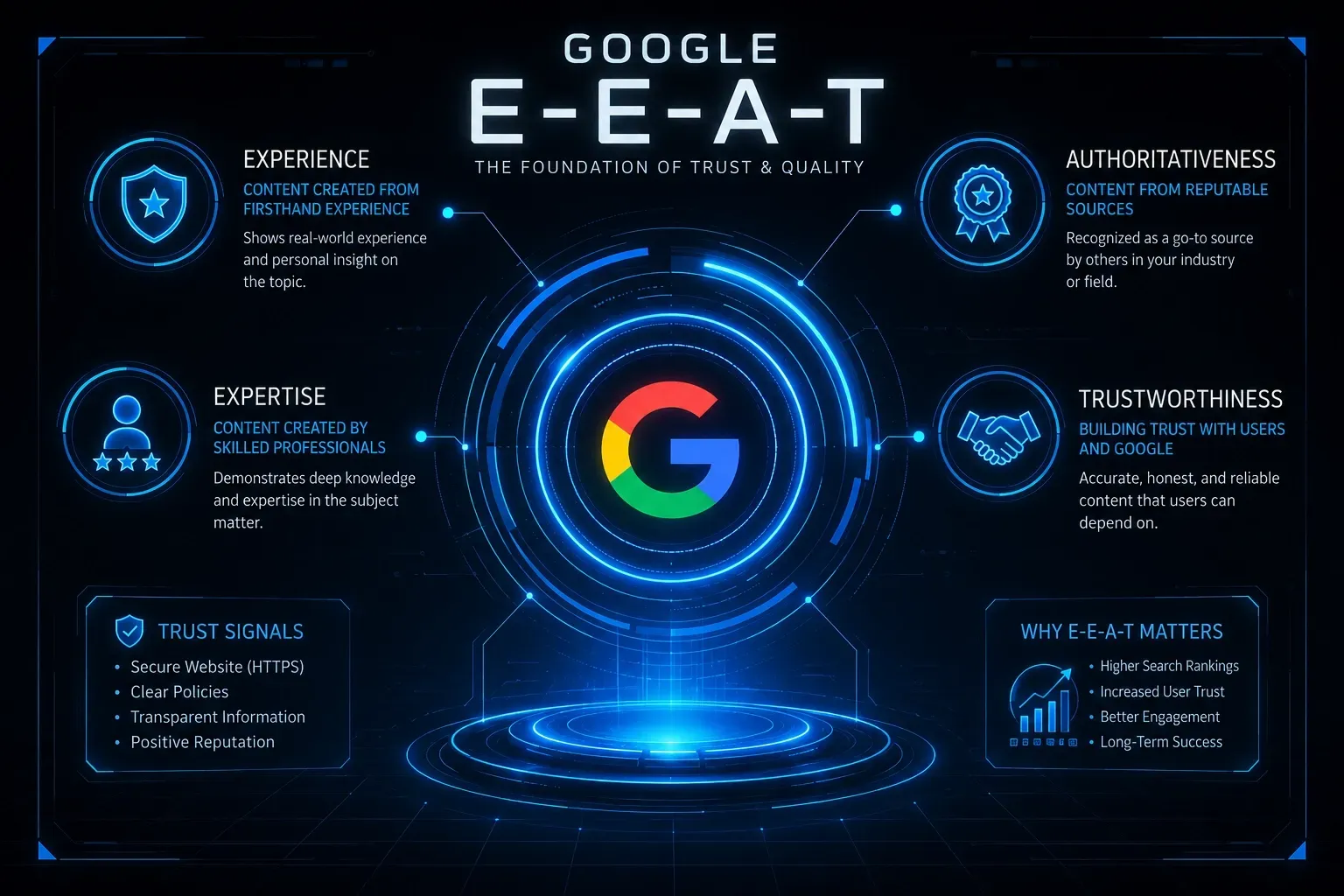
What Is EEAT?
Why It Determines Your Google Rankings
If you manage a local business website — or if you help clients do — you've probably heard the acronym EEAT thrown around in SEO conversations. But what does it actually mean, and more importantly, what does it look like in practice? This post breaks it down in plain language with actionable steps you can start using today.
Experience
Proof you have done
the work firsthand.
Expertise
Depth of knowledge in your field.
Authoritativeness
Recognition by peers
and publishers.
Trustworthiness
Accurate, transparent
reliable content.
The Full Story: Where EEAT Comes From
EEAT stands for Experience, Expertise, Authoritativeness, and Trustworthiness. It's a framework Google's human Quality Raters use to evaluate whether a webpage genuinely serves the person reading it. It was originally EAT (no Experience) when introduced in Google's Quality Rater Guidelines in 2014, and "Experience" was added in December 2022 — a significant upgrade that rewarded first-hand knowledge over purely academic expertise.
The key thing to understand: EEAT is not a direct ranking signal in the algorithmic sense. You won't find an "EEAT score" in Google Search Console. Instead, it is the philosophy behind how Google's algorithm is trained. Pages that genuinely demonstrate these four qualities tend to rank higher, attract more backlinks, and survive algorithm updates far better than thin, generic content.
Breaking Down Each Pillar
Experience
This is the newest and arguably most important pillar for local businesses. Google wants to know: has the person or company behind this content actually done the thing they're writing about? A roofing company that publishes real before/after photos, documents specific job challenges, and shares what they learned on a tricky install is demonstrating experience. A page of recycled tips copied from a trade magazine is not.
How to demonstrate Experience:
→ Publish case studies with real photos, timelines, and outcomes
→ Include first-person language from the owner or lead technician
→ Use job-site photos (not stock) with descriptive file names and alt text
→ Share behind-the-scenes content: what went wrong, what you fixed
→ Add a geo-tagged project gallery organized by service area
Expertise
Expertise means depth of knowledge. For YMYL (Your Money or Your Life) topics — medical, legal, financial — Google expects certified professionals. For most local service businesses, it means demonstrating that you know your trade thoroughly: licensing information, certifications, years in business, awards, or training credentials all contribute.
How to demonstrate Expertise:
→ List licenses, certifications, and accreditations prominently (footer + About page)
→ Create an in-depth author bio for anyone publishing content on your site
→ Write educational content that goes beyond surface-level advice
→ Add FAQPage schema to Q&A content so Google can parse your answers
→ Reference industry standards and code compliance where applicable
Authoritativeness
Authority is largely about what others say about you. It's built through backlinks from reputable local or industry sources, press mentions, chamber of commerce profiles, trade association listings, and consistent reviews. This is the one pillar you can't fake — authority accrues over time through genuine recognition.
How to build Authoritativeness:
→ Pursue local directory listings: BBB, Angi, Houzz, HomeAdvisor, NAHB
→ Get mentioned in local news or community blogs (sponsor events, write guest columns)
→ Earn backlinks by contributing expert quotes to industry publications
→ Build and maintain a robust Google Business Profile with photos and Q&A
→ Encourage satisfied clients to leave detailed, keyword-rich reviews
Trustworthiness
Trust is the foundation on which everything else rests. Google evaluates trustworthiness through the accuracy of information, site security (HTTPS), transparent ownership, clear contact details, privacy policies, and the absence of deceptive practices. For local businesses, NAP consistency (Name, Address, Phone) across all platforms is a direct trust signal.
How to build Trustworthiness:
→ Ensure your site runs on HTTPS with a valid SSL certificate
→ Standardize your NAP across every directory, social profile, and citation
→ Add LocalBusiness schema markup with consistent contact information
→ Publish a clear Privacy Policy and Terms of Service page
→ Never use misleading headlines, fake reviews, or exaggerated claims
→ Display your physical address, not just a contact form
EEAT in the Age of AI Search
With Google's AI Overviews, Perplexity, and ChatGPT now surfacing answers directly in search results, EEAT has never been more important. These AI tools are trained to favor content that signals credibility. If your website doesn't clearly communicate who is behind it, what qualifies them, and why the information can be trusted, AI engines will pass over it and cite a competitor instead.
What does this mean practically?
- Structured data (schema markup) is how you communicate credibility signals in a machine-readable format.
- An about page with real bios, photos, and credentials is no longer optional — it's essential.
- Content that cites facts, references sources, and avoids hedged non-answers gets cited by AI tools.
- Businesses with GEO (Generative Engine Optimization) in their strategy will outpace those who haven't adapted.
EEAT in Practice: Side-by-Side Comparison
| Without EEAT | With EEAT |
|---|---|
| Generic "we do HVAC"copy | Case study: "We replaced 200+ units in Phoenix this summer: |
| No author identified | Named technician/owner with credentials listed |
| No reviews or citations | Google reviews embedded + industry citations |
| No contact info visible | NAP prominent schema markup in place |
| Copied FAQ from competitor | FAQ answers specific local questions from real clients |
| Stock photography only | Real job site photos with geo-tagged metadata |
Where to Start: A Quick-Win Checklist
You don't have to overhaul your entire site at once. Start with these high-impact, lower-effort improvements:
• [This week] Add a detailed About page with real team photos, bios, and credentials
• [This week] Ensure NAP is identical across your website, GBP, and top 10 directories
• [This month] Add LocalBusiness and FAQPage schema markup to key pages
• [This month] Publish one original case study with real project photos and outcomes
• [Ongoing] Request reviews from every satisfied customer — respond to all of them
• [Ongoing] Earn 2–3 new backlinks per month from local or industry sources
• [Ongoing] Keep all content factually accurate and updated at least annually
The Bottom Line
EEAT is Google's way of answering a simple question: "Can we trust this source enough to send our users there?" For local service businesses, that trust is built through real credentials, consistent information, genuine customer reviews, and content that reflects actual on-the-job experience — not polished marketing fluff.
The good news: most of your competitors haven't done this work yet. That's your window.
Ready to Build EEAT Into Your Website?
Oasis Grafx helps local businesses establish credibility with Google and AI search engines through strategic content, schema markup, and authority-building campaigns.