
Geo-Fence Marketing 101: Reach Customers the Moment They're Nearby
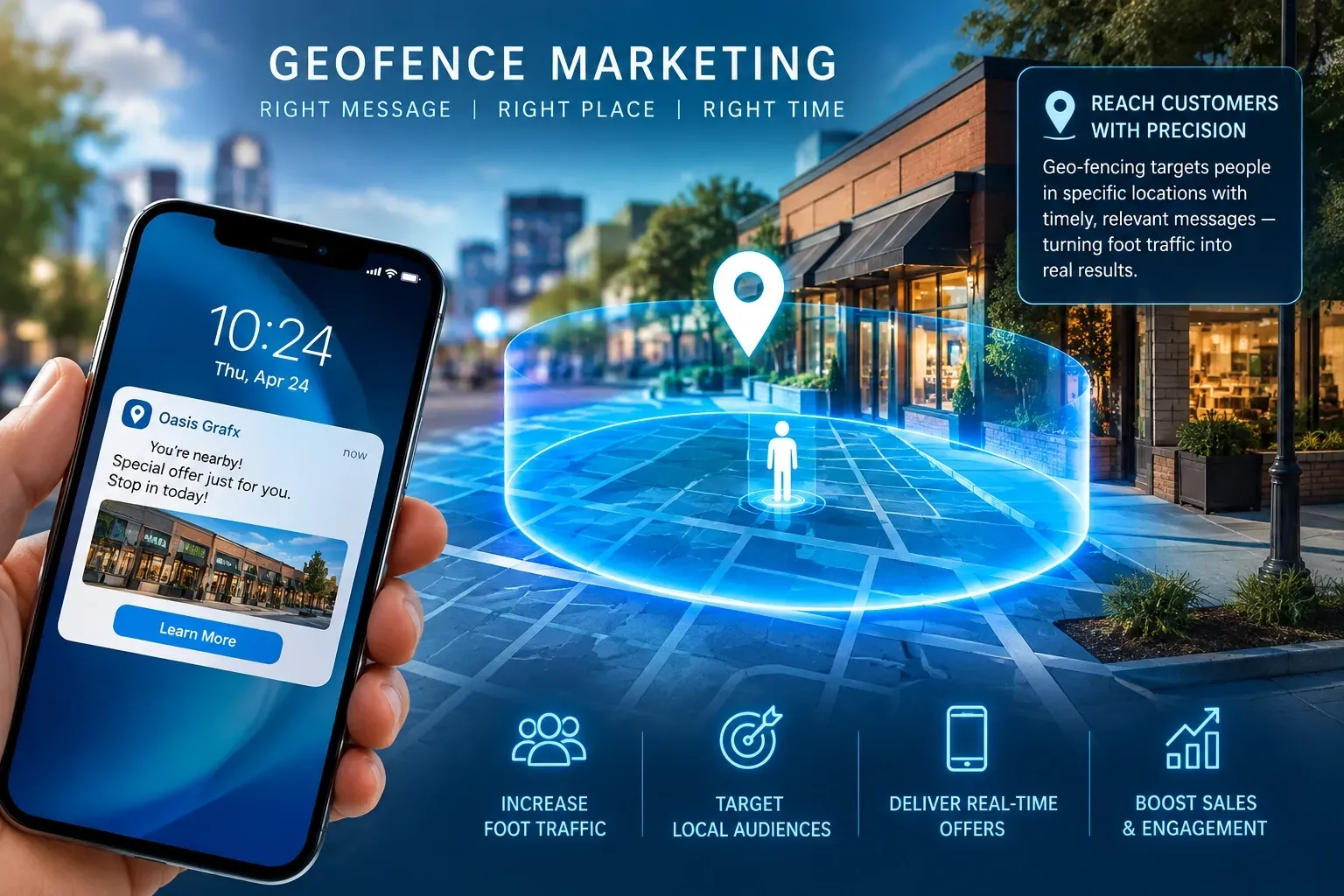
Imagine a customer drives past your storefront, or walks within a few hundred feet of your shop, and within moments an ad for your business shows up on their phone. That's not a coincidence — it's geo-fence marketing, and it's one of the most effective tools small businesses have for turning nearby foot and car traffic into paying customers.
1. What Is Geo-Fence Marketing?
Geo-fencing uses GPS, Wi-Fi, or cell data to draw an invisible boundary — a "fence" — around a specific location. It could be your own storefront, a competitor's location, a shopping center, a stadium, or an entire neighborhood. When someone with location services enabled on their phone crosses into that boundary, it triggers an action: they might see a targeted ad, receive a push notification, or get added to a retargeting list for follow-up ads later.
Unlike traditional local ads that target based on general geography (a city or zip code), geo-fencing is precise — often down to a few hundred feet. That precision is what makes it powerful for small businesses working with limited ad budgets: every dollar goes toward people who are physically close enough to actually walk through your door.
2. Why It Works So Well for Small, Local Businesses
Geo-fencing shines in a few specific situations:
- Foot traffic conversion — Someone browsing shops nearby sees your ad and decides to stop in.
- Competitor conquesting — Fence a competitor's parking lot and serve your ad to their customers as they shop nearby.
- Event and venue targeting — Fence a local fairground, farmers market, or festival to reach people already in a buying or browsing mindset.
- Store visit retargeting — Anyone who visited your location can be served follow-up ads for weeks afterward, keeping your business top of mind.
Because the targeting is location-triggered rather than demographic-guessed, the audience tends to be more relevant, and the cost-per-click is often lower than broader social or search campaigns.
3. Common Ways to Put It to Work
A few practical applications small businesses use most often:
- Radius fencing around your own location to catch nearby traffic during business hours.
- Fencing competitor locations to introduce your brand to shoppers who haven't found you yet.
- Fencing complementary businesses — a landscaper might fence a garden center, for example.
- Seasonal or event-based fencing tied to festivals, sporting events, or holiday shopping windows.
- Trade show or conference fencing for B2B businesses targeting attendees on-site.
4. Getting Started the Right Way
A few things matter more than people expect when setting up a campaign:
- Fence size matters. Too tight and you miss people; too broad and you lose precision and waste spend. A few hundred feet to a half-mile is typical for retail.
- Dwell time settings can help filter out people just passing through versus people who actually stopped.
- Creative still counts. A precise fence with a weak, generic ad won't convert — the offer and design need to earn the click.
- Track store visits, not just clicks, so you can measure whether the campaign is actually driving people through your door, not just impressions.
Have you noticed ads appearing right after you walked past a store? That's geo-fencing in action — and it works the same way for your business.
A Real-world Example
Say you run a single-location retail shop. A reasonable starting budget looks like this: a $5–$15 CPM (cost per thousand), targeting a half-mile radius around your store during business hours, with a monthly ad spend of roughly $500–$1,500 a month.
Conclusion
Geo-fence marketing gives small businesses a way to compete for attention exactly where and when it matters most: when a potential customer is physically close enough to walk in. Paired with the right creative and clear tracking, it's one of the most cost-effective ways to turn local presence into local sales.