
Why Your Ad Traffic Needs a Dedicated Landing Page, Not Your Homepage
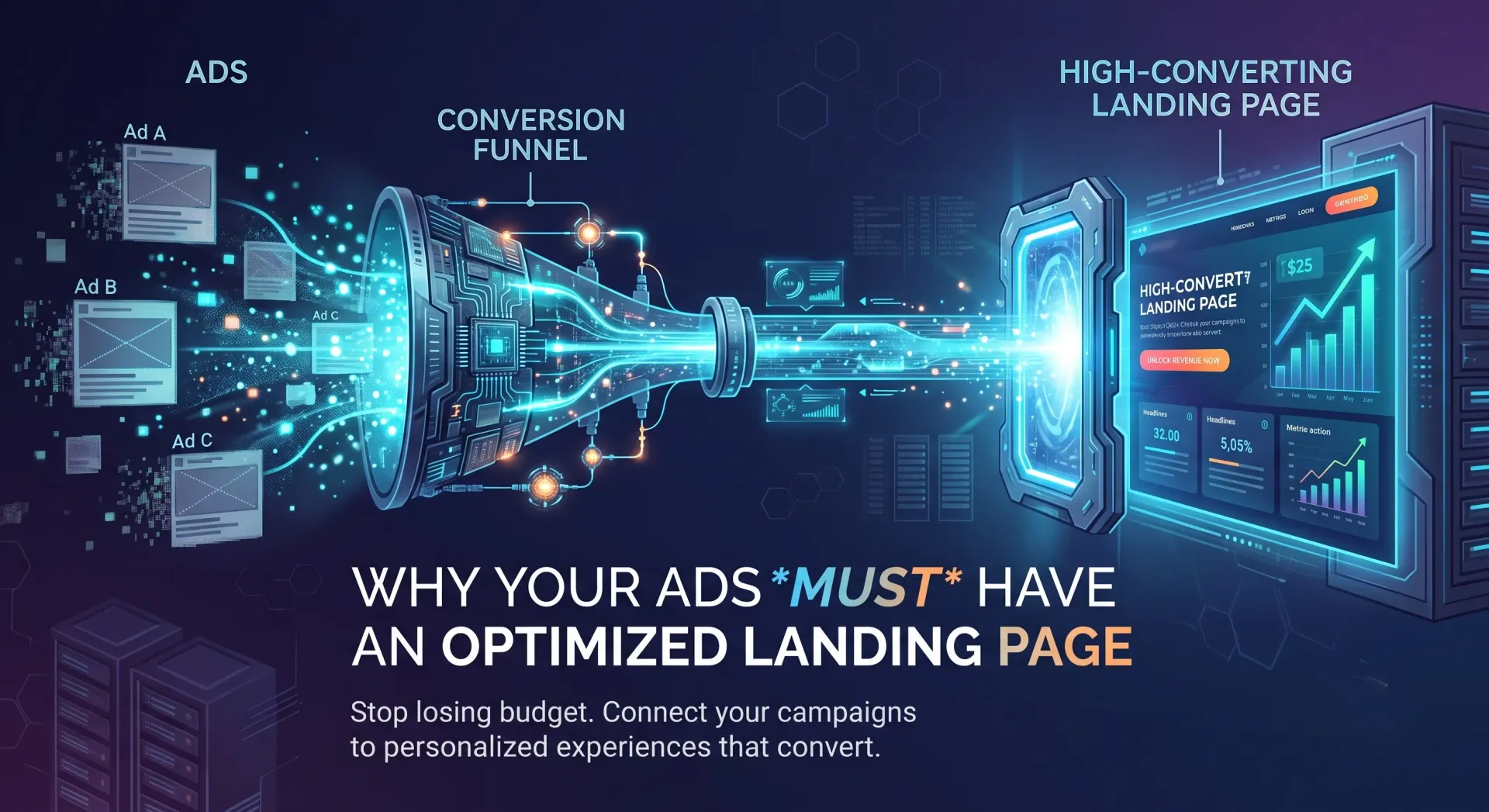
You've written a great ad. The headline is sharp, the offer is clear, and someone clicks it. Then they land on your homepage, and they're gone in seconds. This happens constantly, and it's one of the most expensive, most fixable mistakes in paid advertising: sending ad traffic to a page that wasn't built to receive it.
If you're running Google Ads, Facebook Ads, or any paid campaign and driving clicks to your homepage or a general services page, here's why that's quietly costing you money, and what a dedicated landing page does differently.
1. Your Homepage Is Built for a Different Job
A homepage has to serve everyone: first-time visitors, returning customers, job seekers, vendors, and search engines trying to understand your whole business. It has a navigation menu, multiple calls to action, and links pulling attention in a dozen directions. That's the right job for a homepage. It is the wrong job for a page someone lands on after clicking an ad promising one specific thing.
When someone clicks an ad for "Same-Day AC Repair" and lands on a homepage listing eight different services, a blog feed, and a general "Contact Us" link buried in the nav, you've made them do the work of finding what they clicked for in the first place. Most won't bother. They'll hit the back button, and you've paid for that click either way.
2. Message Match Is What Keeps People From Bouncing
The single biggest driver of landing page performance is message match, whether the page a visitor lands on continues the exact conversation the ad started. If your ad says "Free Estimate on Kitchen Remodels," the page should be about kitchen remodels and should restate that free estimate offer immediately, not make the visitor scroll or search for it.
This isn't just good UX, it's measurable. Google Ads uses landing page relevance as part of Quality Score, which directly affects your cost per click. A page with strong message match and fast load time can lower what you pay for the exact same ad position. A mismatched landing page does the opposite: you pay more per click and convert fewer of the people who do click.
3. One Goal, One Action
A dedicated landing page has exactly one job: get the visitor to take one specific action, whether that's calling, filling out a form, or requesting a quote. Everything on the page should support that single action. That usually means removing the main navigation menu entirely, cutting unrelated services and offers, and placing the call to action above the fold and repeated as the visitor scrolls.
This feels counterintuitive to business owners who are used to their site showcasing everything they do. But a page that tries to do everything converts worse than a page that does one thing extremely well. Every extra link or option on the page is a decision point, and every decision point is a chance for the visitor to leave without converting.
4. What Belongs on an Ad Landing Page
An effective landing page is short, focused, and structured around a few key elements: a headline that mirrors the ad's promise, a subheadline that adds one more compelling reason to stay, proof (reviews, certifications, before-and-after photos, or specific numbers), and a clear, repeated call to action. Trust signals matter more here than almost anywhere else on your site, since this may be the visitor's very first interaction with your business. A phone number that's clickable on mobile, a short and simple form, and a couple of real testimonials do more work than a long page of copy.
It also needs to load fast. Paid traffic is often the least patient traffic you'll get, someone comparing three or four competitors in different tabs isn't going to wait around for a slow page.
5. Tracking Gets Easier, Not Harder
A dedicated landing page also makes measuring what's actually working far simpler. When ad traffic lands on a general page shared by organic visitors, email campaigns, and direct traffic, it's difficult to isolate whether the ad itself is performing. A standalone landing page tied to one campaign gives you a clean conversion rate you can trust, and lets you test headlines, offers, or layouts against each other without other traffic sources muddying the results.
Bringing It Together
Every dollar spent driving traffic to a page that isn't built to convert that traffic is a dollar working against itself. A dedicated landing page costs relatively little to build compared to what most businesses already spend on ad clicks, and it's usually the single highest-leverage fix available to a campaign that isn't performing the way it should.
If you're running ads and sending that traffic to your homepage, that's the first thing worth changing before you spend another dollar on clicks.